


Ashwagandha Benefits: What Does the Research Say About Stress and Sleep?
Explore what research says about ashwagandha for stress, sleep and cortisol, along with potential side effects, safety considerations and interactions.
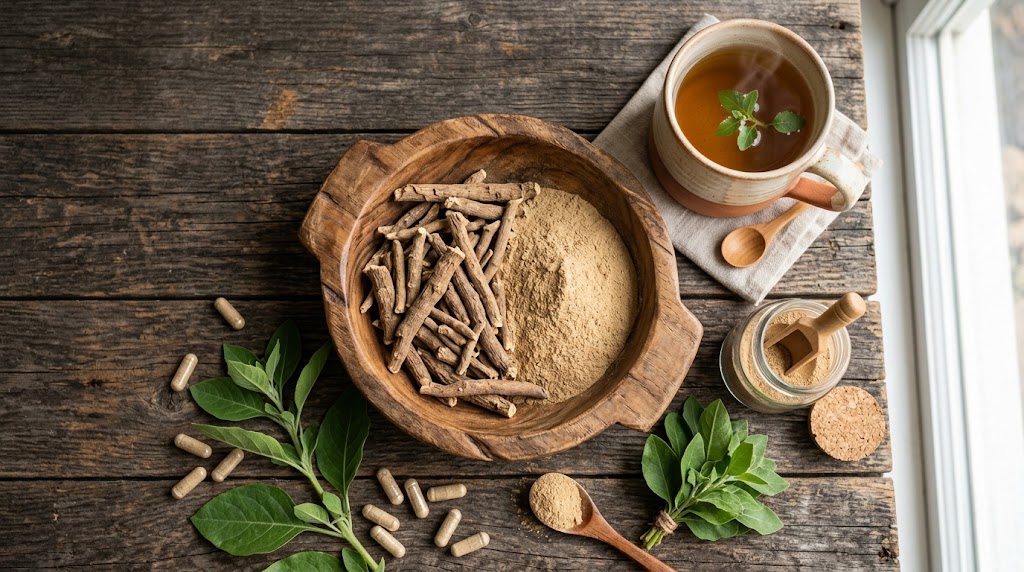
Ashwagandha (Withania somnifera) is an herb with a long history of use in Ayurvedic medicine. Today, it is a common ingredient in dietary supplements marketed around stress, relaxation, and sleep.
But do the scientifically supported benefits of ashwagandha match everything claimed about it? Current research suggests that some ashwagandha extracts may help reduce perceived stress and improve certain aspects of sleep in some people. However, results vary depending on the extract, concentration, dose, and duration of use, and more research is needed, particularly regarding long-term safety.
What Is Ashwagandha?
Ashwagandha is an evergreen shrub scientifically known as Withania somnifera. It is sometimes called Winter Cherry or Indian Ginseng, although it does not belong to the ginseng family.
The plant contains several bioactive compounds, including a group known as withanolides. The chemical composition of the root and leaves differs, which means that ashwagandha extracts used in dietary supplements are not necessarily equivalent.
Ashwagandha is also commonly described as an adaptogen, a term used for substances thought to help the body adapt to different types of stress. However, describing ashwagandha as an adaptogen does not mean that it treats stress or anxiety disorders.
Which Ashwagandha Benefits Are Supported by Research?
It is important to distinguish between the traditional uses of ashwagandha and effects that have been investigated in human clinical trials. At present, some of the clearest evidence relates to stress and sleep, while evidence for many other commonly promoted uses remains limited or insufficient.
1. Ashwagandha and Stress
The potential effect of ashwagandha on stress is among its most extensively studied uses.
Several clinical trials have found that certain ashwagandha extracts were associated with improvements in measures of perceived stress compared with placebo. Some studies have also reported changes in cortisol, a hormone that plays an important role in the body's stress response.
A 2024 systematic review and meta-analysis involving nine randomized controlled trials and 558 participants found improvements in some measures of stress, anxiety, and serum cortisol compared with placebo. However, the researchers also highlighted the need for additional information about the safety of long-term use.
The evidence should therefore not be interpreted as showing that ashwagandha treats anxiety or stress disorders. A more accurate conclusion is that some ashwagandha preparations have shown promising effects on stress in clinical research, while further evidence is still needed.
2. Ashwagandha and Sleep
A limited number of studies suggest that certain ashwagandha extracts may improve some aspects of sleep, including:
- Sleep quality.
- Total sleep time.
- Sleep efficiency.
- Sleep latency, or the time needed to fall asleep.
According to the U.S. National Institutes of Health Office of Dietary Supplements (NIH ODS), effects in some studies were more noticeable among people with insomnia. However, the number of studies remains limited, and the preparations and doses used across trials have varied.
Ashwagandha should therefore not be considered a treatment for insomnia or a substitute for assessing the underlying causes of persistent sleep problems.
3. Ashwagandha and Anxiety
Some research has reported positive findings related to anxiety, but the overall evidence is less conclusive.
The NIH Office of Dietary Supplements notes that ashwagandha extracts may help reduce stress and anxiety, while the National Center for Complementary and Integrative Health (NCCIH) states that the evidence regarding anxiety remains unclear.
For this reason, current findings should not be turned into a claim that ashwagandha treats anxiety disorders.
4. What About Athletic Performance, Memory, and Other Benefits?
Ashwagandha is also promoted for purposes such as athletic performance and cognitive function. However, the strength of the evidence is not the same across all proposed uses.
According to NCCIH, there is currently insufficient evidence to determine whether ashwagandha is beneficial for several other purposes, including athletic performance and cognitive function.
These effects should therefore not be presented as established benefits of ashwagandha based on current evidence.
Does Ashwagandha Lower Cortisol?
Some clinical trials have reported lower cortisol levels in participants taking certain ashwagandha preparations compared with placebo, and systematic research has also identified a potential effect on serum cortisol.
This does not mean, however, that ashwagandha regulates cortisol in everyone or that it can be used to treat conditions associated with abnormal cortisol levels. Extract type, dosage, study population, and other factors vary substantially across studies.
What Is the Appropriate Ashwagandha Dosage?
There is no single ashwagandha dose that can be considered appropriate for every person or every product.
Clinical studies have used different preparations made from the root or from both the root and leaves, with varying concentrations of active compounds. The amounts used and treatment durations have also differed considerably.
As a result, a dose used in one clinical study should not automatically be converted into a general recommendation for all ashwagandha supplements.
When ashwagandha is included in a dietary supplement, consumers should follow the directions and warnings on that specific product's label rather than attempting to determine a dose from research involving a different extract or concentration.
The Saudi Food and Drug Authority (SFDA) also advises consumers to follow dietary supplement label instructions and pay attention to warnings and potential interactions.
Is Ashwagandha Safe?
Current evidence suggests that ashwagandha may be well tolerated by many people during short-term use. Clinical studies provide safety information for periods of up to approximately three months, but there is not enough evidence to determine its long-term safety.
Potential side effects can include:
- Stomach upset.
- Nausea.
- Diarrhea or loose stools.
- Drowsiness.
Rare cases of liver injury have also been associated with some ashwagandha supplements. Research also suggests that ashwagandha may affect thyroid function in some individuals.
Who Should Be Cautious About Using Ashwagandha?
Official health sources identify several groups who should avoid ashwagandha or consult a healthcare professional before using it.
Particular caution is appropriate for:
- Pregnant or breastfeeding women.
- People with thyroid disorders.
- People with autoimmune disorders.
- People who are about to undergo surgery.
- People taking regular medications.
Ashwagandha may also interact with certain medications, including:
- Diabetes medications.
- Blood pressure medications.
- Immunosuppressants.
- Sedatives.
- Some anti-seizure medications.
- Thyroid hormone medications.
Anyone with a chronic health condition or taking regular medication should consult a doctor or pharmacist before using an ashwagandha-containing supplement.
Ashwagandha in Dietary Supplements
Ashwagandha supplements are available in many formulations. Products may contain root extracts or extracts made from both roots and leaves, and the amount and concentration of bioactive compounds can vary between products.
For this reason, seeing the word Ashwagandha on a label—or simply comparing the number of milligrams—is not enough to determine whether two products are equivalent. The full formulation, directions for use, and warnings should also be considered.
The Saudi Food and Drug Authority emphasizes that dietary supplements are not treatments for diseases or substitutes for prescribed medicines. The SFDA also notes that describing a product as "natural" does not necessarily mean that it is safe for everyone.
Ashwagandha in BeCalme
Ashwagandha is one of the ingredients in VITADIET BeCalme. The formulation also contains melatonin, magnesium, Melissa herb, hops cones, vitamins B1 and B6, and other ingredients.
According to product information provided by VITADIET, the formulation contains 50 mg of ashwagandha.
This amount should not be directly compared with doses used in clinical studies because research has used different extracts, concentrations, and formulations. In addition, findings from studies investigating ashwagandha alone do not automatically establish the health effects of a multi-ingredient product containing ashwagandha.
Learn more about BeCalme to review the product information, formulation, directions for use, warnings, and available purchase options.
Health notice: This article is provided for general health education and is not intended to diagnose or treat any medical condition. Consult a doctor or pharmacist if you have a health condition, take medications, or are unsure whether a dietary supplement is appropriate for you.
Sources and References
- National Institutes of Health (NIH) – Office of Dietary Supplements. Ashwagandha: Is it helpful for stress, anxiety, or sleep? Fact Sheet for Health Professionals. Updated May 2, 2025.
- National Center for Complementary and Integrative Health (NCCIH). Ashwagandha: Usefulness and Safety.
- Saudi Food and Drug Authority (SFDA). Dietary supplements are not treatments for diseases or substitutes for prescribed medications. Published February 1, 2024.
- Arumugam V, et al. Effects of Ashwagandha (Withania somnifera) on stress and anxiety: A systematic review and meta-analysis. Explore (NY). 2024;20(6):103062. PMID: 39348746.
- VITADIET. VITADIET 2026 Product Catalogue – BeCalme product information and ingredients.
Frequently asked questions
What are the main researched benefits of ashwagandha?
Some of the clearest human evidence currently relates to stress and sleep. Certain ashwagandha extracts have shown potential benefits in clinical studies, but findings vary by extract, dose, and study population. This does not mean that ashwagandha treats anxiety or sleep disorders.
Should ashwagandha be taken in the morning or at night?
There is no single evidence-based rule that makes morning or evening the best time for everyone. The appropriate timing depends on the specific product, its formulation, and its directions for use, particularly when ashwagandha is combined with other ingredients.
Can ashwagandha be taken every day?
Ashwagandha has been studied for short periods of up to approximately three months, but information about the safety of long-term daily use remains limited. Follow the product directions and consult a doctor or pharmacist if you have a health condition or regularly take medications.
Is ashwagandha suitable during pregnancy or breastfeeding?
Official health guidance recommends avoiding ashwagandha during pregnancy and not using it while breastfeeding because of potential concerns and insufficient safety information for these groups.